New Frontier
Awakening the Angel System: Apocalypse: A LitRPG Progression FantasyNew Frontier is a sovereign country founded on unexplored land after the final struggle against the demonspawn. Known through its principal settlement as Jacksonville, it transforms a former battlefield and bastion of the enemy into a coastal capital, a frontier of exploration, and a test of whether divided peoples can build a common civic life after the loss of mana and the return of hundreds of thousands of the dead.
Foundation and Political Structure
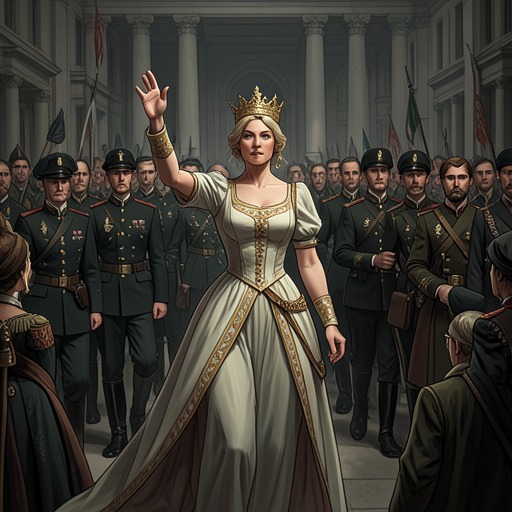
New Frontier emerged from the cooperation of Lita von Strongarm and the Hoshido, who joined together to establish an independent country on the new continent. Its government was led by appointed Speaker Lita von Strongarm, while Kenichi and the other tribal chiefs served as a council. This arrangement distinguished the Frontier from Selfia and her Republic, the other principal state formed after the world’s political order fractured. The two nations remained connected by annual diplomatic meetings at the remains of Heaven, but they operated under separate systems and carried the unresolved resentments of the old wars.
The Frontier’s political identity was therefore born from coalition and compromise rather than from a single inherited imperial institution. Lita’s Paladins remained hostile toward the empire, and Kenichi and many nomads continued to distrust Imperial forces. The unity that had briefly held the final coalition together did not survive unchanged after Jack’s absence, particularly as resurrected people arrived in a world that had moved on without them. New Frontier had to govern not only a new territory but also the legal, social, and emotional consequences of a broken history.
Jacksonville and the Rebuilt Landscape
Jacksonville became the Bastion of the New Frontier and the country’s principal urban center. Five years after Victory Day, its shoreline had become a sunny public space where families and children played, fishermen used the piers, and visitors treated the beach as a tourist attraction. The setting’s ordinary leisure sharply contrasts with the continent’s earlier history as a killing ground: the same broad environment that once received invading armies and poisoned water was being remade as a place for residence, recreation, and civic memory.
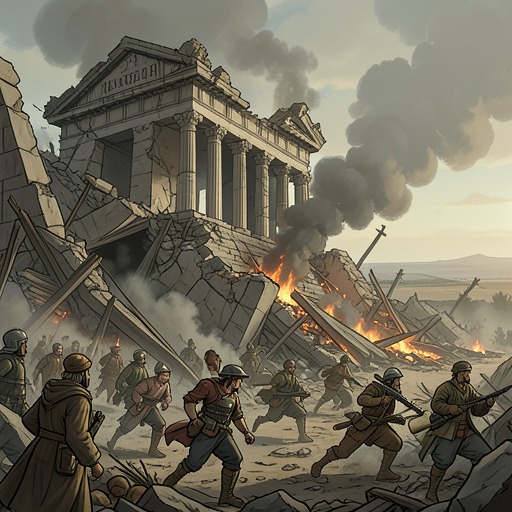
The former stronghold of the demonspawn also became the Frontier’s governmental capital and a forward base for explorers and treasure-seekers. Gold walls and marble pillars survived from the old ruins, but electric signs, wires, homes, and shops had been installed among them. Banners displaying silver wings circled the twelve chairs of the Frontier’s council, combining the remnants of the old sacred architecture with the visible machinery of a new government. The ruins did not disappear; they were made to carry a different social purpose.
Reconstruction remained difficult because the Shutdown had rendered airships, mechs, power generators, and other technological advances inoperable without mana. Excavating and cultivating the land required sustained effort, and the city’s underdark expanded gradually as construction continued. At the same time, New Frontier’s inhabitants explored the immense uncharted territory beyond the settled areas. Its defining frontier was thus both geographic and technological: the country had land to claim, ruins to reinterpret, and infrastructure to rebuild in a world whose former energy system no longer functioned.
Resurrection and Social Crisis
The post-Shutdown world imposed an extraordinary burden on New Frontier and the other surviving governments. Hundreds of thousands of people were resurrected across the world, sometimes appearing in seemingly random places such as bathrooms, ship engine compartments, water wells, and abandoned military installations. These people needed homes and identities, while the governments had to determine how to absorb individuals whose lives belonged to earlier political and historical periods.
The arrival of the resurrected produced disorder, argument, and renewed violence. Many revived people caused problems, and the sudden population increase intensified disputes over how the new world should be administered. New Frontier became one of the principal places where this crisis was managed, with its former enemy bastion converted into a capital capable of housing newcomers. The transformation made the country both a refuge and an administrative experiment: its institutions had to reconcile the living with people returned from the dead, even though the political agreements and social loyalties that had once defined those people had often vanished.
This crisis also exposed the limits of victory. The world’s governments had unified for the final expedition, but shared military purpose did not erase bloodshed, betrayal, or historical suspicion. Without Jack, the personal bond that had helped hold the coalition together weakened, leaving New Frontier to pursue cooperation through councils, agreements, and practical governance rather than through a single charismatic center.
Relations with Selfia’s Republic
New Frontier maintained a formal relationship with Selfia and her Republic. Each year, Ada Nguyen and Selfia met at the remains of Heaven under an agreement between the two nations. Their meetings embodied both continuity and division: the leaders could cooperate on matters affecting the postwar world, yet the Republic and the Frontier remained separate states on different continents, shaped by different political systems and distinct memories of the conflict.
The relationship was especially significant because the Frontier’s leadership included figures who distrusted the empire, while Selfia’s government inherited the burdens of imperial power and responsibility for the wider human order. The two nations had to manage resurrected populations, political instability, and the disappearance of mana while preventing old antagonisms from returning to open conflict. New Frontier’s existence therefore did not signal a simple universal peace. It marked a negotiated separation in which coexistence depended on repeated diplomacy.
Historical Significance
New Frontier gives the book’s ending a concrete political and ecological form. The story’s earlier wars are associated with surrender demands, mass casualties, speeches promising humanity’s survival, and landscapes scarred by poisoned water, shattered earth, and supernatural warfare. In the aftermath, the Frontier turns such spaces into beaches, council chambers, construction sites, homes, and exploratory routes. Its progress is material but never innocent: the rebuilt city stands amid ruins, and its institutions must accommodate people resurrected from the very conflicts that created the new order.
The country also embodies the consequences of the world’s defining technological and metaphysical rupture. Once mana disappears, advanced machines fail, and survival depends on labor, adaptation, and political organization rather than on restoring the former system. New Frontier’s expanding underdark, cultivated land, repaired settlements, and exploratory projects show a society learning to live within that limitation. Its future remains unfinished, but that incompleteness is central to its meaning: New Frontier is not a promised return to the old world, but an improvised civic space in which former enemies, nomads, soldiers, resurrected people, and explorers attempt to make a livable future from catastrophe.